
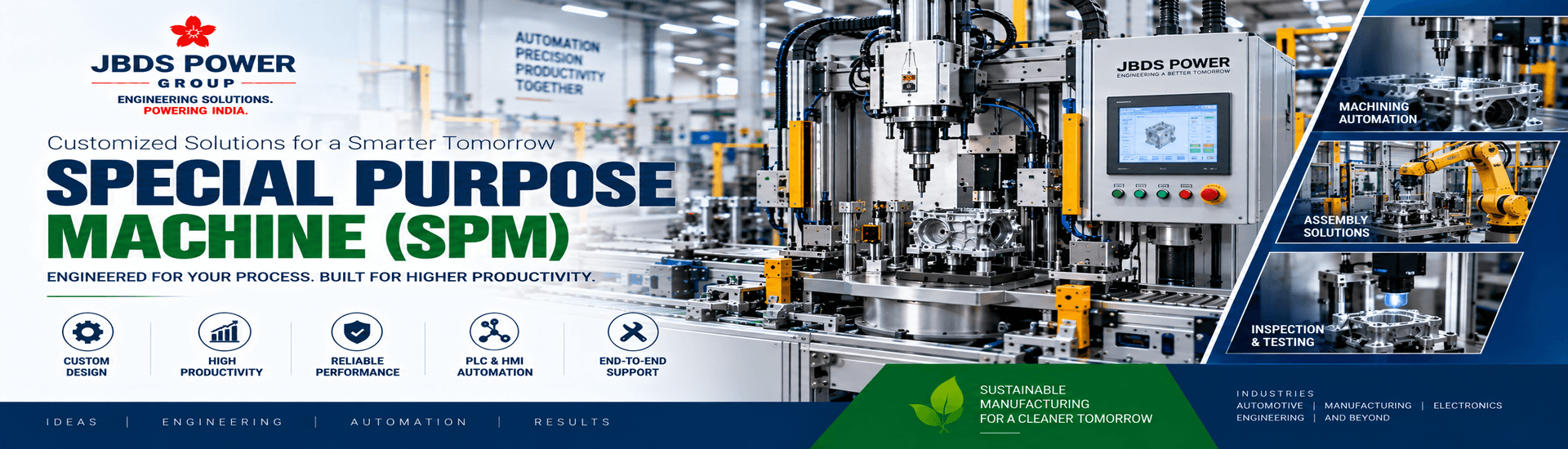
What is a Special Purpose Machine (SPM)?
A Special Purpose Machine, commonly known as an SPM, is a customized industrial machine developed to perform one or more specific manufacturing operations.
Unlike a general-purpose machine designed for multiple applications, an SPM is developed around defined requirements such as:
Component dimensions
Manufacturing operation
Required production output
Cycle time
Accuracy and repeatability
Loading and unloading method
Automation level
Inspection requirements
Available plant space
Safety requirements
The objective is to develop a machine that closely matches the customer's actual manufacturing process.
Why Are SPM Machines Used in Manufacturing?
Consider a component that requires:
Loading → Positioning → Clamping → Drilling → Inspection → Unloading
Performing each operation separately may require multiple machines, operators and material-transfer stages.
A customized SPM can potentially combine several operations into one controlled production sequence.
For example:
Component Loading
↓
Part Detection
↓
Automatic Clamping
↓
Machining / Assembly Operation
↓
Inspection
↓
Cycle Complete
↓
Component Unloading
Depending on the process, this can help reduce manual intervention and improve production consistency.
JBDS Power's current SPM solutions are specifically positioned around improving productivity, reducing manual operations and providing consistent industrial performance.
Types of Special Purpose Machines
SPMs are not limited to one machine configuration. The design changes according to the manufacturing operation.
JBDS Power's current manufacturing capabilities include drilling, tapping, welding, hydraulic, pneumatic, assembly-line, conveyor-integrated, testing, robotic automation and other customized industrial SPMs.
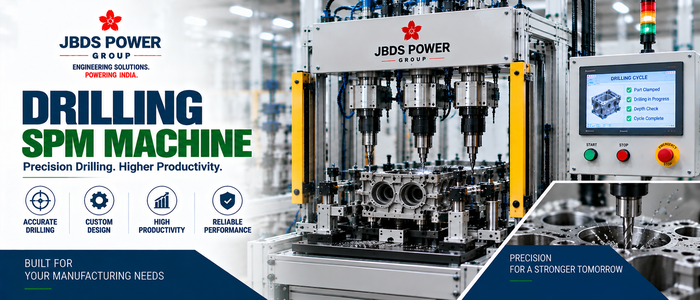
1. Drilling SPM Machine
A Drilling SPM is designed for dedicated drilling operations on specific components.
Depending on the component and production requirement, an SPM can be designed for single or multiple drilling operations.
Important design parameters can include:
Hole Diameter | Hole Depth | Number of Holes | Component Material | Cycle Time | Required Accuracy
Fixtures and clamping mechanisms can be designed around the actual component geometry.
2. Tapping SPM Machine
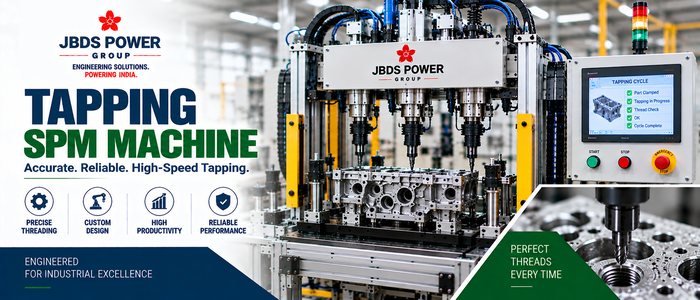
Tapping SPMs automate repetitive threading operations.
A customized system can incorporate:
Component fixtures
Automatic clamping
Controlled tapping
Sensors
PLC sequence
HMI controls
Safety interlocks
The machine configuration depends on the thread specification, component and required production output.
3. Welding SPM Machine
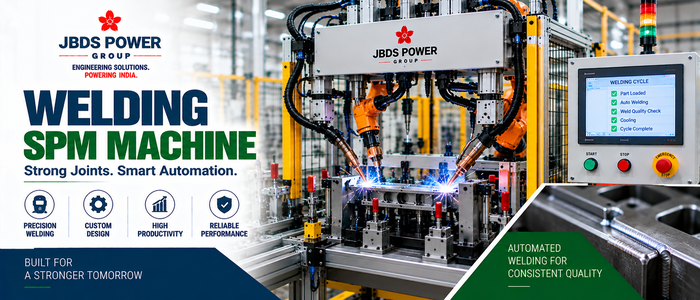
A Welding SPM can be developed where a repeatable welding sequence is required for production components.
Depending on the application, automation can help control:
Component Position → Clamping → Welding Sequence → Process Completion → Unloading
Fixtures are particularly important because they help maintain the required position of components during the welding operation.
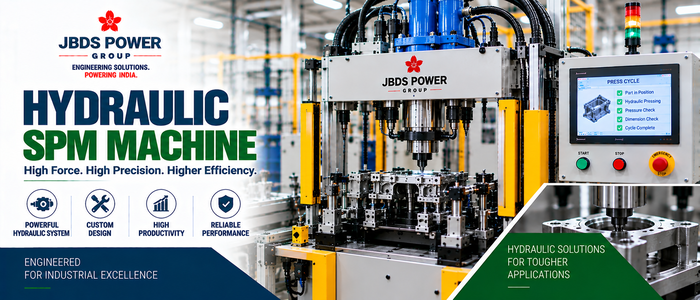
4. Hydraulic SPM Machine
Hydraulic systems can be used in SPMs where controlled force is required.
Applications can include:
Pressing | Clamping | Forming | Assembly | Component Insertion
The hydraulic system should be engineered according to required force, pressure, stroke, speed and operating sequence.
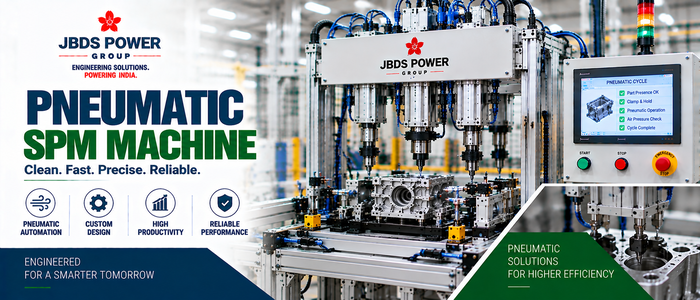
5. Pneumatic SPM Machine
Pneumatic systems are frequently used for:
Clamping | Positioning | Pick-and-Place | Ejection | Light Pressing | Component Transfer
Pneumatic automation can be integrated with sensors and PLC controls to create an automatic operating sequence.
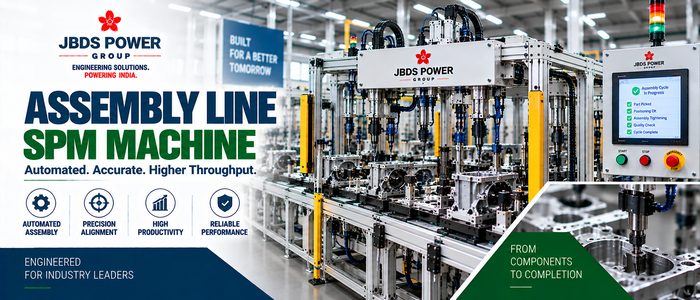
6. Assembly Line SPM
An Assembly SPM is designed to automate or assist a defined product-assembly process.
A typical sequence might look like:
Component Loading → Detection → Positioning → Assembly → Fastening/Pressing → Inspection → OK/NG Decision
Multiple stations can also be integrated into a complete assembly line.
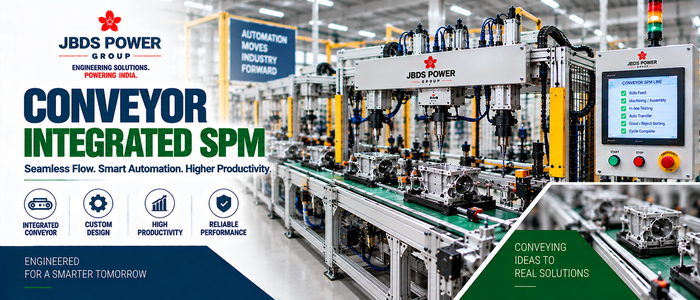
7. Conveyor Integrated SPM
An SPM does not always need to operate as an isolated machine.
It can be integrated with a conveyor or material-handling system:
Conveyor → Component Detection → Stopper → SPM Operation → Quality Check → Conveyor Transfer
This can create a more automated production flow between manufacturing operations.
JBDS Power lists conveyor-integrated SPMs and material-handling applications within its current capabilities.
How Does an SPM Machine Work?
The working principle varies by application, but a typical automated SPM can follow this architecture:
Operator / Conveyor Loads Component
↓
Sensor Detects Component
↓
PLC Verifies Conditions
↓
Fixture Clamps Component
↓
Servo / Hydraulic / Pneumatic System Operates
↓
Manufacturing Process Takes Place
↓
Sensors Confirm Process
↓
PLC Completes Cycle
↓
Component is Released / Transferred
JBDS Power's SPM platform can combine PLC automation, industrial sensors, pneumatic or hydraulic systems, servo drives and precision-controlled mechanisms depending on the application.
PLC & HMI Automation in SPM Machines
The PLC (Programmable Logic Controller) acts as the control system for many automated SPM applications.
It receives signals from sensors and controls the required operating sequence.
The HMI (Human Machine Interface) provides an interface between the machine and operator.
Depending on the project, an HMI can display:
Machine Status | Cycle Information | Operating Parameters | Alarms | Manual Controls | Production Information
JBDS Power's current SPM capability specifically includes PLC/HMI-based automation, servo-controlled operation and safety interlock systems.
Key Features of a Customized SPM Machine
Depending on the application, an industrial SPM can incorporate:
Customized Machine Design
Machine architecture can be developed around the actual component and manufacturing operation.
PLC & HMI Control
Automates machine sequences while providing operator control and monitoring.
Servo-Controlled Motion
Can provide controlled movement and positioning where required by the process.
Sensors & Interlocks
Sensors can monitor component presence, position and process conditions.
Hydraulic / Pneumatic Automation
Can provide controlled movement, clamping and force according to the application.
Robust Industrial Construction
The machine frame and mechanical structure can be engineered for the intended production environment.
Safety Integration
Guards, emergency stops, interlocks and other safety systems can be incorporated according to the machine risk assessment and applicable requirements.
Benefits of Special Purpose Machines
A properly engineered SPM can provide several manufacturing advantages.
Reduced Cycle Time
Combining and automating repetitive operations can reduce unnecessary manual movement between processes.
Improved Productivity
Machines can be engineered around the required production rate and sequence.
Reduced Manual Operations
Automation can reduce repetitive operator intervention.
Improved Accuracy & Repeatability
Fixtures, controlled mechanisms and automation can help provide more consistent manufacturing operations.
Consistent Production Process
A defined PLC-controlled sequence can make repetitive operations more predictable.
Integrated Quality Checks
Where suitable, sensors and inspection systems can be incorporated directly into the machine cycle.
Production-Line Integration
An SPM can communicate or physically integrate with conveyors, robots and other manufacturing equipment.
These objectives are consistent with the productivity, quality, cycle-time, accuracy and repeatability benefits described for JBDS Power's current SPM solutions.
Industries Using SPM Machines
Customized SPM machines can be used across numerous manufacturing sectors.
JBDS Power currently identifies applications across:
Automotive Industry
Manufacturing Plants
Assembly Line Automation
Electrical & Electronics
Packaging
Welding & Fabrication
Heavy Engineering
Conveyor & Material Handling
Industrial Production Units
The actual machine configuration should always be determined by the process requirement rather than the industry name alone.
How to Select the Right SPM Machine?
Before developing an SPM, the customer and machine manufacturer should clearly define the process.
Important information includes:
1. Component Details
Provide component drawings, dimensions, material, weight and relevant tolerances.
2. Required Operation
Clearly define whether the machine will perform:
Drilling | Tapping | Pressing | Welding | Assembly | Testing | Material Handling
or a combination of operations.
3. Required Cycle Time
How many components must be produced per hour or shift?
Cycle-time requirements have a major influence on machine architecture.
4. Accuracy & Repeatability
Critical dimensions and process tolerances should be established before machine design.
5. Loading & Unloading
Determine whether loading will be:
Manual | Conveyor-Based | Robotic | Automatic Feeding
6. Automation Level
Determine whether the project requires:
PLC | HMI | Servo | VFD | Sensors | Pneumatics | Hydraulics | Robot Integration
7. Quality Inspection
Define whether inspection or OK/NG verification needs to happen within the machine.
8. Safety Requirements
Machine guarding, emergency stops, interlocks and operator interaction need to be considered during engineering.
9. Available Floor Space
Plant layout and available machine footprint should be evaluated before finalizing the concept.
SPM Machine Development Process
A well-planned SPM project should progress systematically from requirement definition to production validation.
A practical workflow is:
1. Requirement & Process Study
Understand the component, existing process, production requirement and expected output.
2. Concept Development
Develop the machine concept and automation philosophy.
3. Mechanical & Electrical Engineering
Design the structure, fixtures, mechanisms, electrical system and controls.
4. Manufacturing & Assembly
Fabricate and assemble the machine.
5.PLC/HMI & Automation Integration
Develop machine logic, operator interface and automation sequence.
6. Testing & Validation
Test the machine against agreed operating and production requirements.
7. Installation & Commissioning
Install and commission the machine at the customer facility.
8. Training & Technical Support
Provide operating guidance and post-installation technical support as agreed.
JBDS Power's current capabilities cover machine design and engineering, industrial automation, PLC/HMI development, installation, commissioning, production-line integration and technical support.
Why Choose JBDS Power for SPM Machines?
JBDS Power combines mechanical engineering, machine manufacturing and industrial automation to develop application-specific SPM solutions.
Current capabilities include:
Customized Machine Development
Mechanical Design & Engineering
PLC Programming
HMI Development
Servo Automation
Hydraulic & Pneumatic Systems
Industrial Sensors
Conveyor Integration
Production-Line Integration
Installation & Commissioning
PAN-India Project Support
After-Sales Technical Support
This enables the project to progress from process requirement → machine design → manufacturing → automation → installation → commissioning through an integrated engineering approach.
Looking for a Customized Special Purpose Machine (SPM)?
Every manufacturing process is different. A standard machine may not always meet your required cycle time, accuracy, automation level or production output.
JBDS Power designs and manufactures customized Special Purpose Machines (SPMs) based on your component, process and production requirements.
Whether you need a machine for drilling, tapping, welding, pressing, assembly, testing, inspection or material handling, our engineering team can develop a solution around your manufacturing process.
Share Your Requirement With Us
For an initial SPM assessment, you can share:
Component Drawing / Sample → Required Operation → Cycle Time → Production Target → Accuracy Requirement → Automation Level → Plant Layout
Our SPM Capabilities
Drilling SPM | Tapping SPM | Welding SPM | Hydraulic SPM | Pneumatic SPM | Assembly Line SPM | Conveyor Integrated SPM | Testing Machines | Robotic Automation
From concept and engineering to manufacturing, PLC/HMI automation, installation and commissioning, JBDS Power can support the complete SPM development process.
JBDS POWER PROJECT INTERNATIONAL PVT. LTD.
📞 +91 7290054361
📧 project@jbdspower.com
🌐 jbdspower.com
📍 Plot No. 302, Sector 7, IMT Manesar, Gurugram, Haryana – 122052
Your Process is Unique. Your Machine Should Be Too.