SPM Machine Buying Checklist: 10 Questions Before You Invest
A special purpose machine should solve a clearly defined production problem. Before requesting a quotation, it helps to turn expectations such as “faster production” or “better quality” into requirements that a machine builder can evaluate and demonstrate.
Whether you are planning a dedicated assembly station, a drilling application or an inspection process, this SPM machine buying checklist will help you prepare a more useful project brief.
1. What production problem must the machine solve?
Start with the operation that needs improvement. Is the issue a slow assembly step, inconsistent positioning, repeated manual handling or a difficult inspection task? Record the present method and identify the specific result you want to change.
A clear problem statement helps keep the quotation focused. For example: “Automate component positioning and inspection for this part family” gives the supplier more direction than “We need complete automation.”
2. Which components and variants must it handle?
Prepare component drawings, material information, dimensions and representative samples. Explain whether the machine will run one component or several variants, and identify the differences between them.
Ask how fixtures and tooling will accommodate those variations. Include expected future parts where possible, so that the proposed scope distinguishes current requirements from optional expansion.
3. What output and cycle time are required?
Specify the target number of accepted parts per shift and the time actually available for production. Include loading, unloading, inspection and changeovers when discussing cycle time.
For example, producing 600 accepted parts in six net production hours requires an average of one accepted part every 36 seconds. This is an illustrative planning calculation, not a promised machine performance figure. Rejects and unplanned stoppages may require additional capacity.
4. How will quality be checked?
List the characteristics that determine whether a part passes: dimensions, component presence, assembly position or another measurable requirement. Agree on the inspection method and acceptance limits.
Ask what happens when a part fails. Will the machine stop, separate the component or flag it for review? Also clarify whether you need production records, inspection results or part-level traceability.
5. How much automation fits the process?
Discuss whether manual loading, semi-automatic operation or a fully integrated station best fits your production needs. Compare staffing requirements, part presentation, changeovers and maintenance access.
The right scope depends on the process. A focused automated station may be a useful first step when upstream and downstream operations are still changing.
6. What space, utilities and integration are available?
Share the proposed installation layout, access routes and available utilities. Ask the supplier to specify the machine footprint, service clearances and utility requirements in the proposal.
If the SPM will connect to another machine or conveyor, define the transfer method, signals and responsibility for integration. Agree how a stoppage at one station should affect the rest of the line.
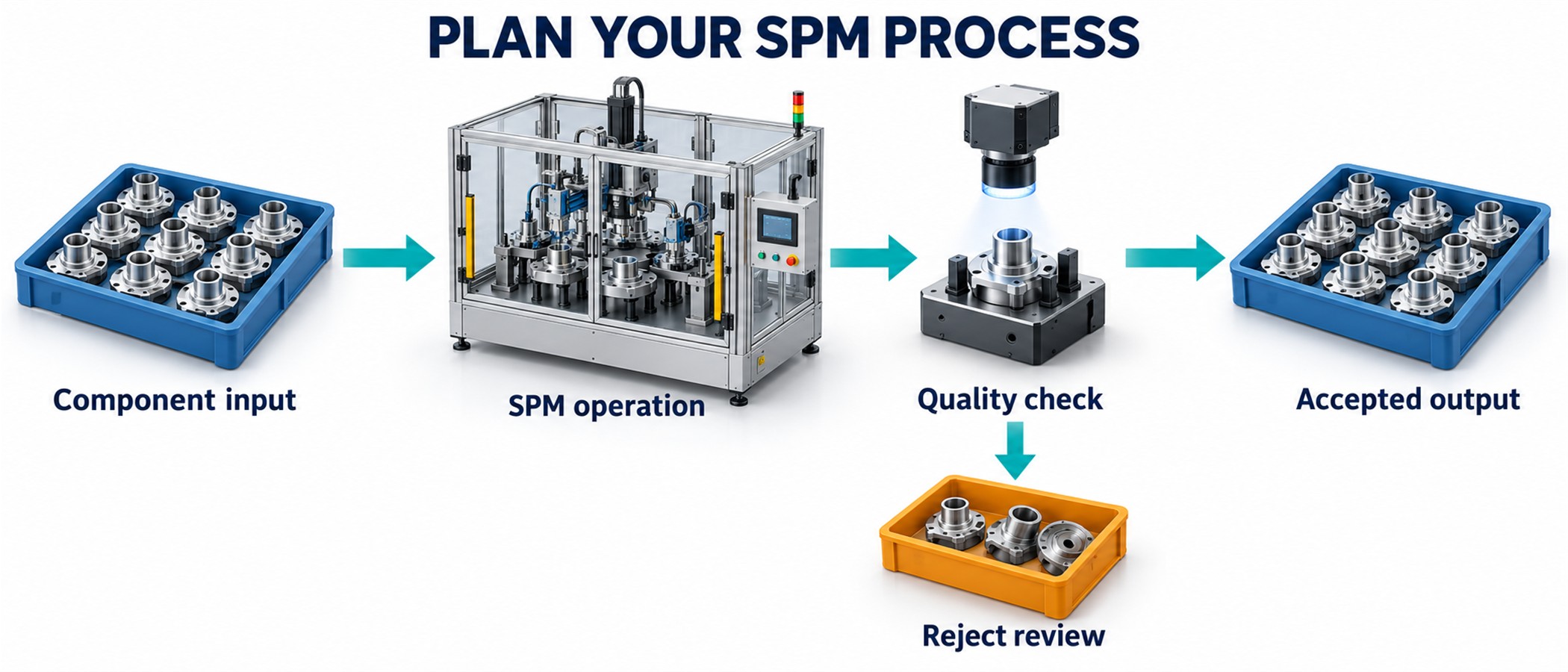
Illustrative SPM process flow: component input, operation, inspection and output.
7. How will operation and maintenance be managed?
Review operator access, guarding, emergency controls and maintenance procedures with the machine builder. Ask how operators will receive fault messages and recover from common interruptions.
Request a maintenance schedule and a list of recommended spare parts. Confirm who will provide training, documentation and support, and what is included in the quoted price.
8. What will the machine trials demonstrate?
Agree on a written trial plan before ordering. Define the sample parts, operating conditions, run duration, quality checks and output criteria used to assess the machine.
Clarify which checks will happen at the supplier’s facility and which will happen after installation. Document how open issues will be recorded and resolved before acceptance.
9. What is included in the total project cost?
Compare quotations on the same scope. Check tooling, fixtures, controls, installation, transport, commissioning, training and support rather than looking only at the base machine price.
For an internal business case, use your own production data to estimate potential benefits and running costs. Keep assumptions about utilisation, rejects and maintenance visible; actual results depend on operating conditions.
10. What information should you send with an enquiry?
Prepare a brief containing the operation to automate, component drawings and samples, required output, quality criteria, variant list, available space and utilities, integration needs and preferred project schedule.
Highlight any unknowns that need a feasibility discussion. A shared written brief makes it easier to compare proposals and agree what successful delivery looks like.
Discuss Your SPM Project with JBDS Power
JBDS Power offers customized special purpose machines and industrial automation services. Explore our Special Purpose Machine solutions to learn more about the applications and services we describe.
Ready to discuss a production requirement? Contact JBDS Power with your component details, process requirements and target output to start a project discussion.