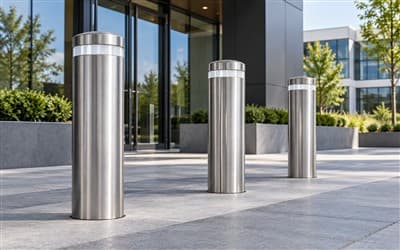

Fixed vs Removable Bollards: Choosing Around Daily Site Access
The delivery van arrives just as staff begin walking through the entrance. Someone needs to open the route, the driver needs a clear place to wait, and pedestrians still need a comfortable way past. This is where a bollard choice becomes a daily operating decision.
Fixed and removable bollards can both form part of a site access plan. The useful question is which parts of the site should stay closed to vehicles and which need to open occasionally. Start there, before comparing finishes or ordering a matching row of posts.
Start with an ordinary working day
Walk the site with the people who use it. Note where staff arrive, where visitors stop and how deliveries reach their unloading point. Then consider the less frequent movements: maintenance contractors, larger vehicles and planned events.
A route that opens once a month has a different operating burden from one used throughout the day. Ask who will manage each opening and whether that person is normally nearby. A neat plan on a drawing can become frustrating if every delivery requires a long search for a key holder.
Our bollard access control planning guide looks at the wider entrance routine, including visitors and pedestrian movement.

Where fixed bollards make sense
Fixed bollards remain in position during normal operation. They are worth discussing where the boundary should not routinely open, such as a forecourt edge or a clearly defined separation beside a vehicle route.
Their practical advantage is that staff do not need to remove and replace them each time the area is used. But that permanence also makes the layout important. Check that a proposed line does not block a legitimate service route or make everyday movement awkward.
Agree the purpose of the installation with the supplier. A bollard used to mark a boundary is not automatically a tested vehicle impact barrier. Appearance, diameter and the word “fixed” do not establish crash performance. Where impact protection is required, the specified product, supporting evidence and installation design need appropriate review.

Where removable bollards may suit the site
Removable bollards allow a planned opening by taking the post out of its installed position, according to the product design. They may suit occasional access to a service yard or an area that normally stays closed to vehicles.
Think through the whole task: unlock, remove, store, manage the opening, replace and secure. Ask about the weight of the selected post and the handling method. A removable arrangement needs somewhere suitable for the removed bollard to go, rather than leaving it across a walkway or leaning against a doorway.
Also ask what remains at ground level when the post is removed. The selected socket or base arrangement, its cover and the surrounding surface should be reviewed for the intended use. Confirm the manufacturer's operating and maintenance instructions before handover.

Test the choice against deliveries and exceptions
Picture a familiar delivery arriving while the usual facilities contact is away. Who can open the route? How will the driver know where to wait? Who makes sure the bollard is secured again when the vehicle leaves?
These questions help reveal whether a manually removable solution fits the routine. Frequent opening may justify discussing other options with the supplier, including an automatic arrangement where appropriate. The decision should follow the actual access requirement, site assessment and operating resources.
Agree emergency and other exceptional access arrangements with the responsible site team and relevant parties. Do not assume that the normal key-holder procedure will meet every situation. Record responsibilities and keep them usable for the people on duty.

Keep the pedestrian route part of the design
Bollards change the way people move through a space as well as the way vehicles enter it. Review the route with pedestrians in mind, including people using mobility aids, people carrying parcels and staff moving equipment.
Ask the designer to review clearances, visibility and the transition between the vehicle route and the walkway. Choose the final layout through the applicable site and accessibility requirements rather than copying spacing from a photograph.
It can be sensible to combine fixed sections with a deliberately managed opening. That keeps the access decision focused on where vehicles need to pass while the rest of the boundary remains defined. The exact arrangement still needs site-specific design.

Compare the installation and handover scope
A product price is only part of a useful comparison. Ask what is included in the proposal: site assessment, foundation or fixing design, installation, surface reinstatement, operating accessories and handover information.
Share available information about ground conditions, underground services, drainage and the existing surface. The installer should establish what further checks are needed before work begins. Fixed and removable products can have different installation requirements, so avoid assuming that one existing detail suits both.
For a removable arrangement, include keys, storage and the replacement routine in the handover. For all installations, identify who will inspect the equipment and how damage or operating problems will be reported. Our bollard installation planning checklist can help structure the enquiry.

What to share with JBDS Power
Send a simple site sketch, photographs, the routes that should stay closed and the routes that need to open. Add the usual vehicle types, opening frequency and the people responsible for managing access. Explain whether the purpose is traffic management, boundary definition or a separately assessed protection requirement.
Explore JBDS Power bollard solutions or discuss your site with our team. A clear description of an ordinary day is a useful starting point for choosing an arrangement your team can operate.
Images are illustrative concepts, not photographs of completed JBDS Power installations. Layout and product selection require site-specific review.