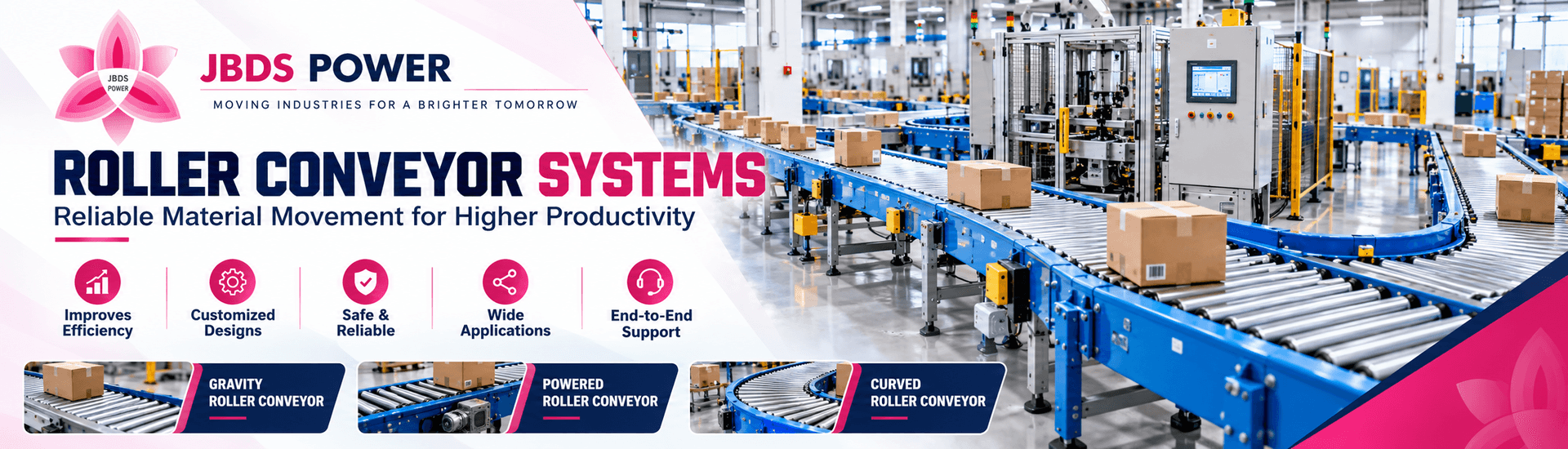
Introduction to Roller Conveyor Systems in Modern Manufacturing
Modern manufacturing plants, warehouses and assembly lines depend on efficient material movement. From transporting cartons and industrial components to handling pallets and finished products, businesses require material handling systems that improve productivity, reduce repetitive manual work and maintain consistent production flow.
A Roller Conveyor System is one of the most widely used material handling solutions for moving products along a defined path using a series of cylindrical rollers.
Depending on the application, a roller conveyor can operate through gravity, an external motor and transmission system, or individually controlled motor-driven rollers.
JBDS Power, a customized Roller Conveyor Manufacturer in India, provides industrial conveyor systems designed around customer-specific material handling, production and automation requirements.
Our roller conveyor solutions can be engineered for manufacturing plants, assembly lines, packaging facilities, warehouses, logistics operations and industrial automation projects.
This guide explains the working principle, components, types, technical design parameters, industrial applications, advantages, automation possibilities and selection process of Roller Conveyor Systems.
What Is a Roller Conveyor System?
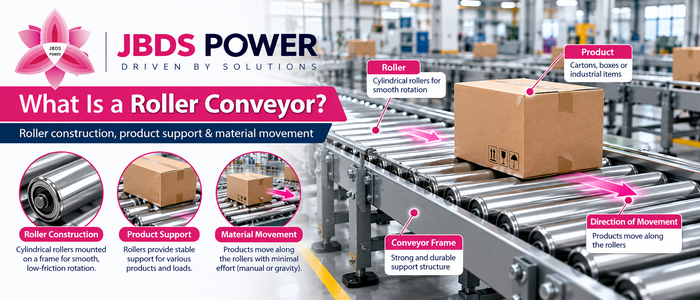
A Roller Conveyor System is a mechanical material handling system that uses multiple rotating cylindrical rollers mounted on a supporting frame to transport products between locations.
The rollers provide a series of contact surfaces over which the product moves.
Unlike a belt conveyor, where products rest on a continuous moving belt, a roller conveyor supports the product on individual rollers.
Roller conveyors are particularly suitable for items with reasonably stable, rigid or appropriately supported bottom surfaces.
Common materials handled by roller conveyors
Cartons and cardboard boxes
Plastic crates and containers
Industrial components
Automotive parts
Pallets and material handling platforms
Packaged finished goods
Assembly components
Warehouse totes
Metal or wooden trays
Products mounted on suitable fixtures
The conveyor configuration depends on the product's dimensions, weight, bottom-surface condition, required speed and transfer process.
Why do industries use roller conveyors?
Roller Conveyor Systems help establish a repeatable material movement path between workstations, machinery, inspection areas, packaging lines and dispatch points.
For suitable applications, they can reduce manual handling, improve workflow consistency and support automated production processes.
How Does a Roller Conveyor System Work?
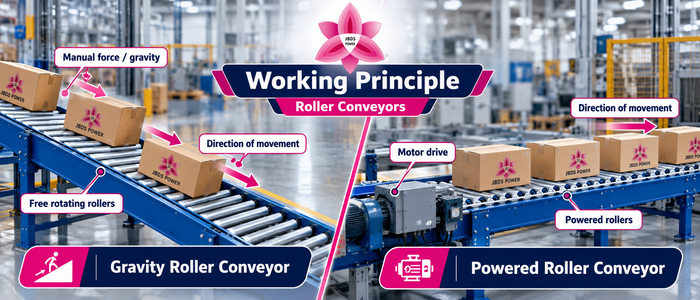
The working principle of a roller conveyor depends on whether the system uses gravity or powered rollers.
In both configurations, products are supported by a series of rollers and transported along the conveyor frame.
1. Gravity Roller Conveyor Working Principle
A Gravity Roller Conveyor does not require a motor to rotate its rollers.
The rollers rotate freely when a product is pushed or when gravity causes the product to move along a properly inclined conveyor.
Working sequence:
PRODUCT LOADING → GRAVITY / MANUAL FORCE → ROLLER ROTATION → PRODUCT MOVEMENT → UNLOADING
For gravity-driven movement, the conveyor must have sufficient slope to overcome rolling resistance and other losses.
The required inclination depends on product weight, roller bearing resistance, product dimensions and contact characteristics.
2. Powered Roller Conveyor Working Principle
A Powered Roller Conveyor uses an electric drive arrangement to rotate selected rollers.
The drive may transmit power through chains, belts or another suitable mechanism.
As the rollers rotate, friction between the rollers and the product's bottom surface moves the product along the conveyor.
Working sequence:
PRODUCT LOADING → MOTOR ACTIVATION → DRIVE TRANSMISSION → ROLLER ROTATION → PRODUCT TRANSFER → DISCHARGE
Powered conveyors are suitable where controlled movement, consistent speed or automated material transfer is required.
3. Automated Roller Conveyor Working Principle
An automated roller conveyor can incorporate sensors, controllers, motor drives and PLC logic.
For example, a photoelectric sensor may detect a carton approaching an inspection station.
The controller can then coordinate conveyor movement according to the required process sequence.
Automated sequence:
PRODUCT DETECTED → SENSOR SIGNAL → PLC / CONTROLLER → MOTOR CONTROL → PRODUCT MOVEMENT → NEXT WORKSTATION
The exact logic depends on the equipment and automation architecture.
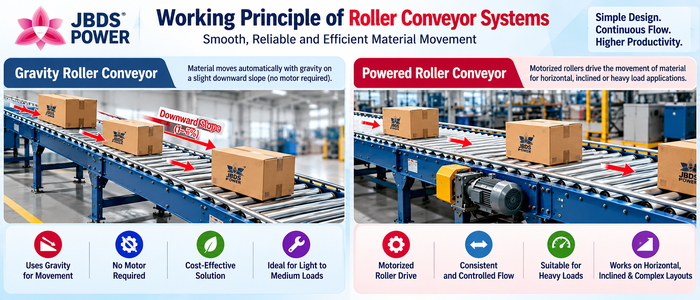
Main Components of an Industrial Roller Conveyor
An industrial roller conveyor combines mechanical, structural and, where required, electrical and automation components.
Understanding these components is important for correct system selection and maintenance.
Conveyor Rollers
Rollers are the primary load-supporting components.
They may be manufactured using steel, stainless steel, suitable polymer materials or other engineered constructions.
Roller diameter, wall thickness, bearing arrangement and surface finish are selected according to the application.
Conveyor Frame
The conveyor frame supports the rollers and other components.
Frames may be manufactured using fabricated steel, stainless steel or suitable aluminium profiles depending on loading and environmental requirements.
Roller Bearings
Bearings allow rollers to rotate with controlled resistance.
Bearing selection influences load capacity, service life, rolling performance and maintenance requirements.
Roller Shafts and Axles
Shafts support the roller assembly and transfer the mechanical load to the conveyor frame.
Their dimensions and mounting arrangement must be suitable for the design load.
Motor and Gearbox
Powered roller conveyors may use a motor and gearbox to provide the required operating torque and speed.
Chain or Belt Drive
Depending on the powered-conveyor design, chains or belts transfer motion from the drive system to the rollers.
Side Guides
Side guides help maintain product alignment where required.
They should be designed to prevent unwanted product movement without creating excessive friction or jamming.
Sensors
Sensors can detect product presence, position, accumulation conditions or movement between conveyor zones.
PLC and HMI
A PLC can coordinate conveyor sequencing and communication with other machines.
An HMI can provide operating controls, status information and alarms where incorporated.
Safety Devices
Depending on the risk assessment, safety provisions can include guarding, emergency-stop systems, safety interlocks and controlled maintenance isolation.
The complete component configuration should be engineered according to the intended duty.
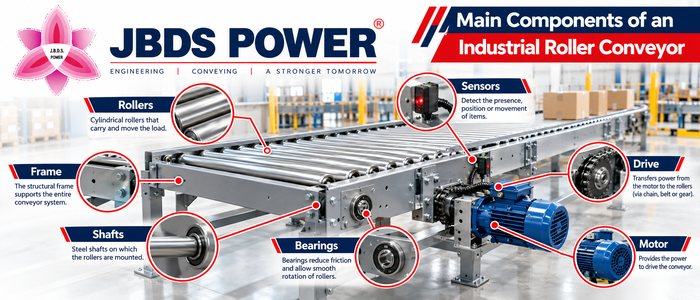
Types of Roller Conveyor Systems
Roller conveyors are available in different mechanical and automated configurations.
Selecting the correct type depends on product characteristics, production volume and required control.
1. Gravity Roller Conveyor
A Gravity Roller Conveyor uses freely rotating rollers without a powered drive.
It is commonly considered for:
Manual packing stations
Warehouse dispatch areas
Loading and unloading operations
Carton movement
Short-distance transfers
Workstation-to-workstation movement
Main advantage: Simple construction with no conveyor drive motor.
Limitation: Product movement and speed are not inherently controlled by a powered drive.
2. Powered Roller Conveyor
A Powered Roller Conveyor uses motor-driven mechanical transmission to rotate the rollers.
It is suitable for applications requiring continuous or controlled product movement.
Common uses include manufacturing, packaging, warehouse transport and production-line integration.
Main advantage: Controlled movement without relying on manual pushing or conveyor inclination.
3. Motor-Driven Roller (MDR) Conveyor
An MDR conveyor uses motorized rollers, often with individual zone controllers.
A motorized roller may drive additional rollers in its zone through suitable transmission elements.
This configuration can support zoned product movement and accumulation control.
Main advantage: Independent control of conveyor zones where the selected system supports it.
4. Chain-Driven Live Roller Conveyor
A Chain-Driven Live Roller Conveyor uses a chain transmission system to rotate the rollers.
It can be suitable for certain heavier industrial loads and applications requiring positive mechanical drive transmission.
Drive configuration, chain protection, load capacity and maintenance access require careful engineering.
5. Heavy-Duty Roller Conveyor
Heavy-duty roller conveyors are designed for applications involving larger or heavier products.
Examples include industrial pallets, machinery components and appropriately supported fabrication assemblies.
The system may require larger rollers, stronger shafts, reinforced frames and higher-capacity drive components.
6. Flexible Roller Conveyor
A Flexible Roller Conveyor can be extended, compressed or arranged into a suitable curved path, depending on its design.
It is often considered for variable loading and unloading arrangements.
7. Curved Roller Conveyor
A Curved Roller Conveyor changes the direction of product movement within the material handling layout.
Curved sections require attention to product stability, roller geometry and speed.
8. Accumulation Roller Conveyor
An Accumulation Roller Conveyor allows products to queue before entering another process.
Some designs permit controlled product accumulation with reduced contact pressure between items.
In a properly engineered zero-pressure accumulation system, sensors and zone controls can maintain separation between products.
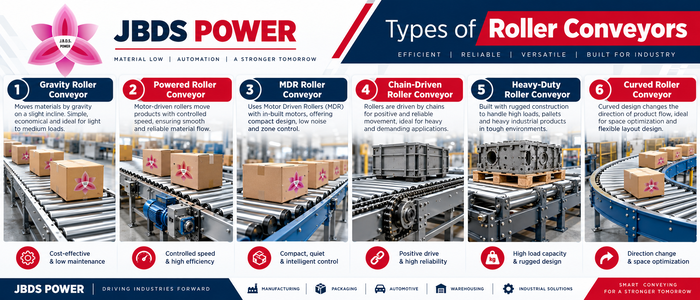
Gravity Roller Conveyor vs Powered Roller Conveyor
Gravity and powered roller conveyors are both useful, but they are designed for different operating requirements.
Parameter | Gravity Roller Conveyor | Powered Roller Conveyor |
|---|---|---|
Drive system | No conveyor motor | Electric motor or motorized rollers |
Movement | Gravity or manual force | Powered roller rotation |
Speed control | Limited without additional controls | Can be controlled |
Initial complexity | Generally lower | Generally higher |
Electrical power | Not required for basic gravity movement | Required |
Automation integration | Limited without additional equipment | Suitable for automated control |
Typical use | Manual transfer, packing, dispatch | Production lines, warehouses, automated handling |
Maintenance | Mainly rollers, bearings and structure | Rollers, bearings, drives and controls |
Which roller conveyor should you choose?
A Gravity Roller Conveyor may be appropriate when movement is intermittent, product handling is relatively simple and powered transport is unnecessary.
A Powered Roller Conveyor may be more appropriate when controlled speed, continuous transfer, accumulation or machine integration is required.
The final decision should consider throughput, product stability, operating cost, safety and overall process requirements.
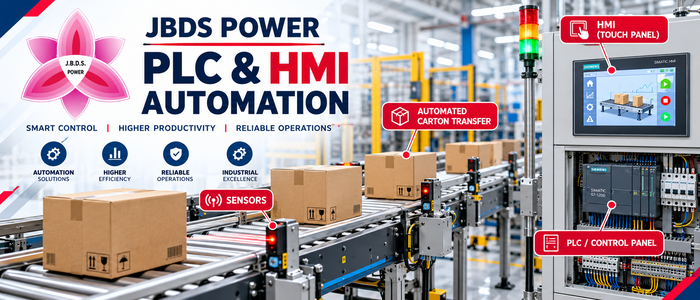
Automated Roller Conveyor Systems with PLC and HMI
Modern factories increasingly require conveyor systems that communicate with other machines and automation equipment.
An Automated Roller Conveyor System can integrate mechanical conveying with electrical drives, sensors and industrial control systems.
JBDS Power provides customized conveyor engineering with PLC and HMI integration according to project requirements.
Possible automation features
Automatic conveyor start and stop
Product presence detection
Product counting
Conveyor zone control
Accumulation logic
Motor speed control
Workstation synchronization
Barcode or identification system integration
Sorting and diversion control
Alarm and fault indication
Machine interlocking
HMI operator controls
Production-line status monitoring
Emergency-stop and safety-system integration
Example: Automated Carton Transfer
Consider a packaging facility where cartons need to move from a packing machine to a labeling station.
Step 1: A carton leaves the packing machine.
Step 2: A sensor detects the carton at the roller conveyor entry.
Step 3: The control system authorizes product movement.
Step 4: The powered rollers transfer the carton toward the labeling station.
Step 5: The downstream sensor detects the arriving carton.
Step 6: Conveyor movement is coordinated with the labeling machine.
Step 7: After the operation is complete, the carton transfers toward the next station.
This process can help reduce repeated manual transfer and improve coordination between production equipment.
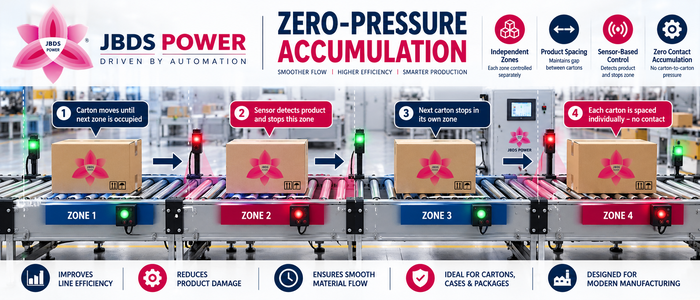
Zero-Pressure Accumulation and Roller Conveyor Zoning
In packaging and warehouse automation, products do not always move continuously.
Sometimes cartons need to wait while downstream equipment completes an operation.
This creates a requirement for accumulation.
What is zero-pressure accumulation?
Zero-pressure accumulation is a conveyor control approach designed to queue products while minimizing or avoiding contact between adjacent items.
A conveyor is divided into individually controlled zones.
Each zone can detect the presence of a product and coordinate movement with neighboring zones.
Typical accumulation sequence
A product enters an available zone.
A sensor confirms product presence.
The controller checks whether the next zone is available.
If available, the product advances.
If occupied, the product remains in its current zone.
Movement resumes when downstream space becomes available.
Benefits of controlled accumulation
Improved product spacing
Reduced unwanted product contact
Better coordination with downstream machines
More controlled queue management
Support for automated packaging and logistics operations
The actual accumulation capability depends on the conveyor hardware, controller and operating logic.
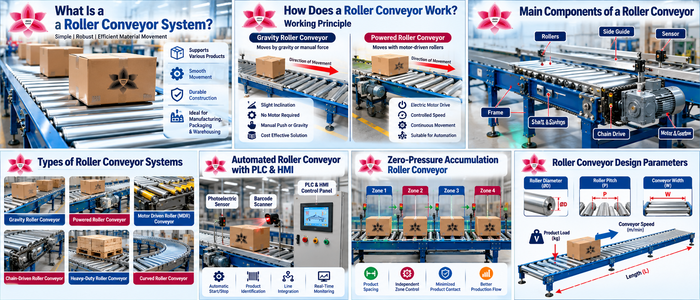
Roller Conveyor Design Parameters and Engineering Calculations
A roller conveyor should be designed according to the actual product and production process.
Selecting rollers only by conveyor length or width can result in unsuitable loading, unstable movement or premature component wear.
1. Product Dimensions
Determine the product length, width and height.
The bottom contact area is especially important because it determines how the product is supported by the rollers.
2. Product Weight
Consider both individual product weight and the maximum total load on the conveyor.
The design must account for roller load capacity, shaft strength, frame deflection and operating conditions.
3. Roller Diameter
Roller diameter influences load capacity, contact geometry and mechanical performance.
The appropriate diameter depends on roller construction and the intended duty.
4. Roller Pitch
Roller pitch is the center-to-center distance between adjacent rollers.
A common preliminary design approach is to ensure that the shortest product is supported by at least three rollers during transport.
Preliminary guideline:
Roller Pitch ≤ Minimum Product Contact Length ÷ 3
For example, if the minimum product contact length is 300 mm:
300 ÷ 3 = 100 mm
A preliminary roller pitch of 100 mm or less may be considered.
This is a starting guideline, not a substitute for verifying the product's bottom geometry, roller capacity, transitions and stability.
5. Conveyor Speed
Conveyor speed depends on required throughput, product spacing and process cycle time.
For a simplified single-lane system:
Theoretical Throughput (products/hour) = 3600 × Conveyor Speed (m/s) ÷ Product Pitch (m)
Example:
Conveyor Speed = 0.30 m/s
Product Pitch = 0.75 m
Theoretical Throughput = 3600 × 0.30 ÷ 0.75
Theoretical Throughput = 1,440 products/hour
This calculation assumes consistent movement and spacing without delays. Actual throughput can be lower because of accumulation, machine cycle times, transfers and downtime.
6. Conveyor Length and Width
Dimensions should match product size, available factory space, transfer points and maintenance access.
7. Drive and Motor Selection
Powered conveyors require suitable torque, speed and drive sizing.
These depend on the load, friction, acceleration, transmission efficiency and operating duty.
8. Operating Environment
The design may need to account for dust, moisture, temperature, cleaning requirements and corrosion exposure.
9. Safety and Accessibility
Guarding, emergency access, maintenance space and product transfer hazards should be evaluated during design.
JBDS Power can develop customized roller conveyor designs according to customer-specific material handling and automation requirements.
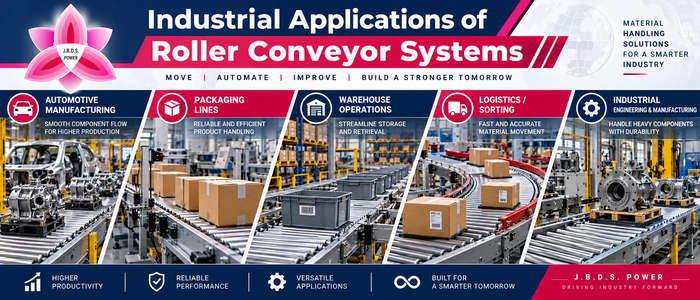
Applications of Roller Conveyor Systems in Manufacturing
Roller Conveyor Systems can be used in many industrial environments.
Their suitability depends on the product being handled and the required movement process.
Automotive Manufacturing
Roller conveyors can transfer automotive components, fixtures, trays and suitably supported assemblies between workstations.
Warehouses and Logistics Centers
Roller conveyors can support carton movement, packing, sorting, dispatch and warehouse transfer operations.
Packaging Industry
Powered and gravity roller conveyors can move cartons and packaged products between packaging, inspection, labeling and dispatch stations.
FMCG Manufacturing
Suitable roller conveyors can assist with secondary packaging, carton handling and finished-goods transfer.
Electrical and Electronics Industry
Roller conveyors can transport products on suitable trays, totes or fixtures between manufacturing and inspection stations.
Pharmaceutical Industry
Where compatible with facility and hygiene requirements, roller conveyors can support secondary packaging and carton movement.
Industrial Engineering Plants
Heavy-duty roller conveyors can be engineered for machinery components, fabricated assemblies and other supported industrial loads.
E-Commerce Fulfillment Centers
Automated roller conveyors can be used for carton and tote transport, accumulation and routing within warehouse material handling systems.
Roller Conveyor vs Belt Conveyor vs Chain Conveyor
Different conveyor technologies are suitable for different material handling requirements.
Feature | Roller Conveyor | Belt Conveyor | Chain Conveyor |
|---|---|---|---|
Carrying surface | Multiple rollers | Continuous belt | Chains or chain-supported carriers |
Suitable products | Stable-bottom cartons, totes, pallets | Small items, packages, supported or bulk materials depending on design | Heavy loads, pallets, fixtures and industrial products |
Gravity operation | Available | Not typical | Not typical |
Accumulation | Available in suitable designs | Requires suitable control/design | Application-dependent |
Product support | Discrete roller contacts | Continuous surface | Discrete chain/carrier contacts |
Automation | Available | Available | Available |
Key selection factor | Product base and roller support | Belt compatibility and product characteristics | Load and positive drive requirements |
A Roller Conveyor is not automatically better than a Belt Conveyor or Chain Conveyor.
The correct selection depends on the product, transfer method, operating environment and production requirements.
Benefits of Industrial Roller Conveyor Systems
A properly engineered roller conveyor system can offer several operational benefits.
1. Reduced Manual Material Handling
Conveyors can reduce repetitive pushing, carrying and transferring of products between stations.
2. Improved Production Flow
A defined conveyor route helps maintain organized movement between processes.
3. Flexible Layout Options
Straight, curved, modular and customized arrangements can be considered according to the factory layout.
4. Automation Integration
Powered roller conveyors can interface with sensors, PLCs, HMI systems and other industrial equipment.
5. Controlled Product Accumulation
Suitable zoned systems can manage product queues and reduce unnecessary contact.
6. Scalable Material Handling
Conveyor systems can be engineered with expansion and future production changes in mind.
7. Reduced Transfer Delays
For suitable processes, automated conveying can reduce waiting time associated with repeated manual movement.
8. Customized Load Handling
Roller diameter, frame structure, drive arrangement and other components can be selected for the application.
9. Maintenance Accessibility
Many roller conveyor designs allow inspection and replacement of individual rollers and associated components, subject to their construction.
10. Production-Line Integration
Roller conveyors can connect assembly, testing, inspection, packaging and dispatch operations into a coordinated material handling process.
Roller Conveyor Safety and Maintenance
Safe operation and regular inspection are important for both gravity and powered roller conveyors.
Moving rollers, chains, sprockets and transfer points can create pinch, nip and entanglement hazards.
Important safety provisions
Appropriate guarding for hazardous moving components
Emergency-stop arrangements where required
Safe access to operating areas
Properly designed product transfer points
Clearly defined loading limits
Suitable maintenance isolation procedures
Operator training
Safe jam-clearing procedures
Powered conveyors should be isolated and secured against unexpected startup before maintenance or jam clearing.
Recommended maintenance checks
Roller rotation and condition
Bearing noise or damage
Chain or belt drive condition
Motor and gearbox operation
Loose fasteners and frame alignment
Sensor alignment
Electrical connections
Conveyor cleanliness
Side guide condition
Unusual vibration or product movement
Maintenance frequency should be based on the manufacturer's recommendations and actual operating conditions.
How to Select the Right Roller Conveyor System
Before purchasing an industrial roller conveyor, it is important to evaluate the complete application.
The following parameters should be shared with the conveyor manufacturer:
Parameter | Information required |
|---|---|
Product type | Carton, pallet, tray, crate, component |
Product dimensions | Length × Width × Height |
Maximum product weight | Weight per unit |
Product bottom | Flat, ribbed, palletized or irregular |
Conveyor length | Required transfer distance |
Conveyor width | Required usable conveying width |
Conveyor height | Loading and unloading levels |
Conveyor type | Gravity, powered, MDR or heavy-duty |
Throughput | Products per minute or hour |
Conveyor speed | Required operating speed |
Layout | Straight, curved, modular or customized |
Automation | Sensors, PLC, HMI, accumulation |
Environment | Indoor, outdoor, dusty, wet or other |
Safety requirements | Guarding, interlocks, emergency controls |
Future expansion | Additional stations or increased capacity |
For example, a warehouse transferring lightweight cartons may require a very different roller conveyor from an automotive facility moving heavy components on industrial fixtures.
This is why custom engineering is important for reliable long-term operation.
Customized Roller Conveyor Systems by JBDS Power
Every manufacturing plant has a different layout, material flow, product range and production target.
A standard conveyor may not always match the required dimensions, transfer points, loading conditions or automation sequence.
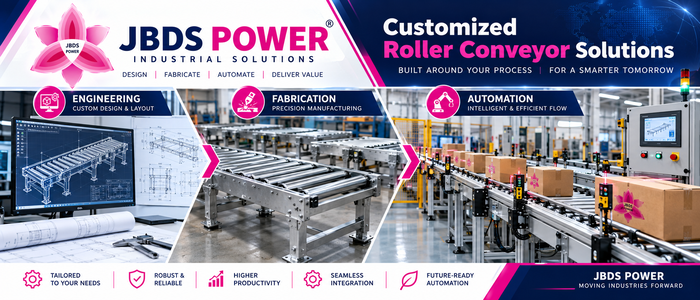
JBDS Power provides customized Roller Conveyor Systems and industrial material handling solutions designed according to customer-specific requirements.
Our conveyor engineering scope
Application and requirement analysis
Site survey and layout evaluation
Customized conveyor mechanical design
Roller and frame selection
Load and drive calculations
Industrial fabrication and manufacturing
Gravity roller conveyor solutions
Powered roller conveyor solutions
Heavy-duty conveyor engineering
Motor and gearbox integration
Sensor integration
PLC and HMI automation
Electrical control panel integration
Production-line integration
Installation and commissioning
Testing and technical support
The objective is to deliver a conveyor system that supports the customer's production process rather than forcing the process to adapt to a standard design.
Why Choose JBDS Power as Your Roller Conveyor Manufacturer in India?
Selecting a roller conveyor manufacturer involves more than purchasing rollers and a supporting frame.
The complete system must match product handling, throughput, layout, controls, safety and future operating requirements.
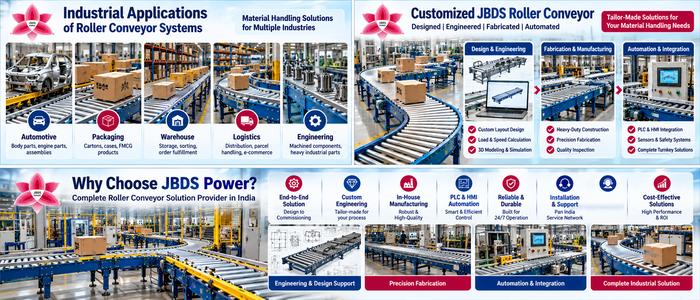
JBDS Power combines industrial engineering, mechanical fabrication and automation expertise to develop customized conveyor systems for manufacturing and logistics applications.
Why industries consider JBDS Power
Customized Engineering: Conveyor dimensions and configurations developed around actual requirements.
Industrial Manufacturing Capabilities: Mechanical engineering, fabrication and equipment integration.
PLC and HMI Integration: Automation options for controlled material handling and production-line coordination.
Multiple Conveyor Technologies: Belt, roller, chain, slat, assembly-line and other customized conveyor systems.
Industrial Project Experience: Conveyor solutions integrated with broader manufacturing and automation projects.
Installation and Commissioning Support: Engineering support through system installation and testing.
Technical Support: Assistance with equipment operation, maintenance and future requirements.
JBDS Power aims to provide complete conveyor and material handling solutions for customers looking to improve their industrial production processes.
Frequently Asked Questions About Roller Conveyor Systems
1. What is a Roller Conveyor System?
A Roller Conveyor System is a material handling system that uses a series of cylindrical rollers to move products between locations.
2. How does a Gravity Roller Conveyor work?
Gravity roller conveyors use freely rotating rollers. Products move through manual force or gravity when the conveyor has a suitable inclination.
3. What is a Powered Roller Conveyor?
A Powered Roller Conveyor uses an electric drive system to rotate rollers and transport products at a controlled speed.
4. What is the difference between Gravity and Powered Roller Conveyors?
Gravity conveyors rely on gravity or manual force, while powered conveyors use motor-driven roller movement.
5. What is an MDR Conveyor?
An MDR Conveyor uses motor-driven rollers, commonly arranged in controlled zones, to transport products.
6. Can Roller Conveyors be integrated with PLC and HMI systems?
Yes. Suitable powered roller conveyors can integrate with PLCs, HMI interfaces, sensors and motor drives for automated operation.
7. Are Roller Conveyors suitable for heavy loads?
Yes, when specifically designed for the intended load. Roller, bearing, shaft, frame and drive capacity must be verified.
8. What is Zero-Pressure Accumulation?
Zero-pressure accumulation is a controlled conveying method that allows products to queue while minimizing or avoiding contact between adjacent items.
9. How do I select roller pitch?
Roller pitch depends on product contact length, bottom geometry and load. A common preliminary guideline is to support the shortest product on at least three rollers.
10. What industries use Roller Conveyor Systems?
Applications include manufacturing, automotive, packaging, warehouses, logistics, engineering and other suitable material handling operations.
11. Can JBDS Power manufacture customized Roller Conveyors?
JBDS Power offers customized industrial conveyor manufacturing and automation solutions, including roller conveyor systems.
12. What details are required for a Roller Conveyor quotation?
Product dimensions, weight, conveyor length, width, height, throughput, layout and automation requirements are useful for preparing a technical proposal.
Contact JBDS Power for Customized Roller Conveyor Systems
Are you planning a new manufacturing line, warehouse material handling system, packaging line or industrial automation project?
JBDS Power can help evaluate your application and develop a suitable Roller Conveyor System.
For faster technical evaluation, share:
Product type and dimensions
Maximum product weight
Required conveyor length and width
Loading and unloading height
Required throughput
Gravity or powered conveyor preference
Plant layout or site drawing
Automation and control requirements
Installation location
JBDS POWER GROUP
Phone: +91 7290054361
Email: digital@jbdspower.com
Email: info@jbdspower.com
Office: Plot No. 302, Sector 7, IMT Manesar, Gurgaon, Haryana – 122052
Explore our solutions:
Customized Conveyor Systems – JBDS Power
Belt Conveyor Systems – JBDS Power
Customized Conveyor Systems: Types & Benefits
JBDS Power – Customized Engineering, Industrial Automation and Smarter Material Handling Solutions.