
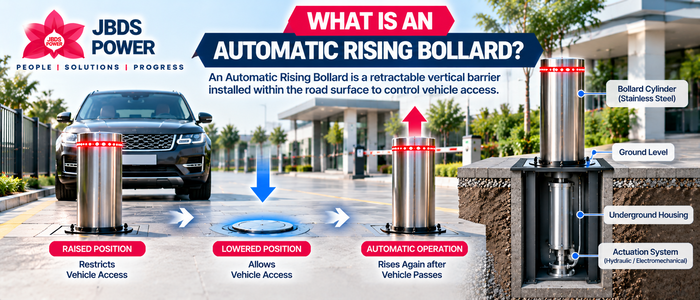
What is an Automatic Rising Bollard?
An Automatic Rising Bollard is a retractable vertical barrier installed within the road or driveway surface to control vehicle movement.
When the entrance needs to remain secured, the bollard stays in its raised position above ground level.
When an authorized vehicle needs access, the control system sends a command to the bollard mechanism. The bollard lowers into its underground housing, allowing the vehicle to pass.
After the vehicle clears the controlled area, the bollard rises again.
The basic operation can be represented as:
ACCESS RESTRICTED → BOLLARD RAISED
AUTHORIZED VEHICLE → BOLLARD LOWERS → VEHICLE PASSES → BOLLARD RISES
This makes automatic bollards especially useful at locations requiring frequent controlled vehicle entry and exit.
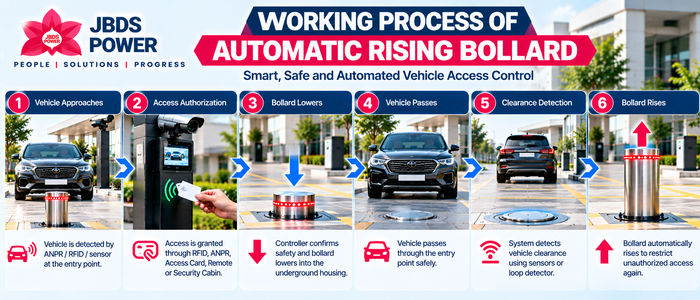
How Does an Automatic Rising Bollard Work?
An Automatic Rising Bollard combines mechanical movement, an actuator or drive system, electronic controls, vehicle-detection devices and access-control equipment.
A typical operating sequence is:
Vehicle Approaches → Access Request → Authorization → Controller Receives Signal → Safety Check → Bollard Lowers → Vehicle Passes → Clearance Confirmed → Bollard Rises
Authorization can be provided through an appropriate access-control system depending on project requirements.
Possible control methods include:
• Remote Control
• RFID
• Access Card
• Security Cabin Control
• Push Button
• Access Control System
• ANPR Integration
• PLC / Central Controller
Safety devices are particularly important. The system should be engineered so that the bollard does not rise while an authorized vehicle remains over the controlled area.
JBDS Power's existing Bollard Systems article similarly identifies access control, RFID, security-cabin and controller integration as possible automatic-bollard operating methods. JBDS Power
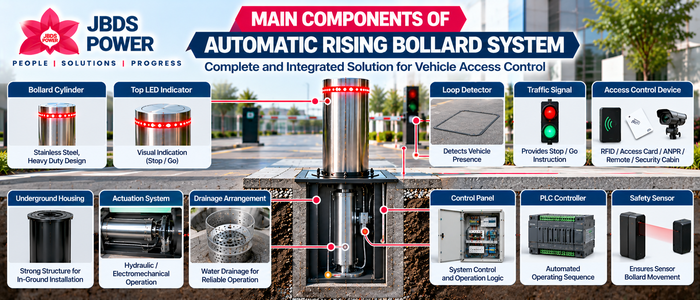
Main Components of an Automatic Rising Bollard System
An automatic bollard installation consists of more than the visible metal cylinder above the road.
Depending on system design, major elements can include:
• Bollard Cylinder – The visible retractable structure that rises above ground.
• Underground Housing – Installed below road level to accommodate the bollard when lowered.
• Drive / Actuation Mechanism – Provides the movement required to raise and lower the bollard.
• Control Panel – Manages system commands and operating logic.
• PLC / Bollard Controller – Controls automated operating sequences where applicable.
• Vehicle Detection System – Detects vehicle presence around the bollard area.
• Safety Sensor – Helps prevent unsafe bollard movement.
• Loop Detector – Can detect vehicles within a defined road zone.
• Traffic Signal – Provides drivers with visual Stop / Go instructions.
• Access-Control Device – RFID, remote, access card, ANPR or another authorized input.
• Drainage Arrangement – Helps manage water around underground equipment.
• Emergency / Manual Controls – Can be incorporated according to project requirements.
The exact configuration depends on traffic frequency, site conditions, required security level and selected control architecture.
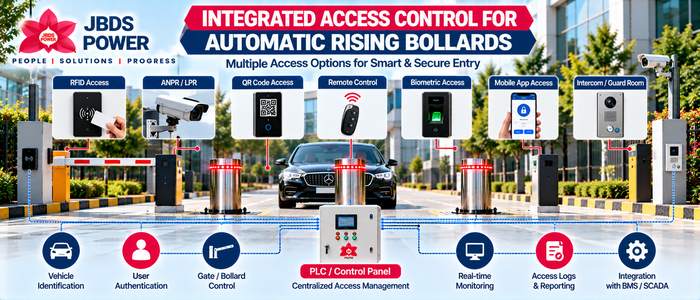
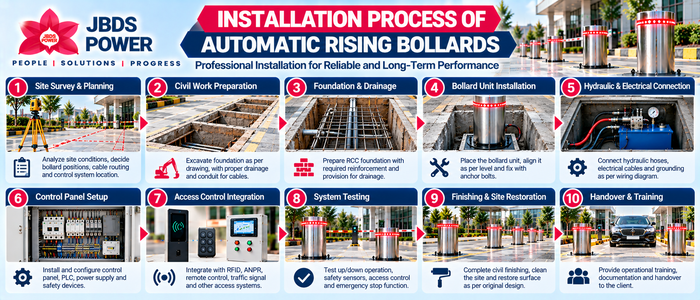
Automatic Bollard Access Control Integration
One of the biggest advantages of an automatic rising bollard is its ability to integrate with electronic access-control systems.
Instead of requiring a security operator to manually remove a physical barrier each time a vehicle enters, authorization can be processed electronically.
A typical architecture can be:
ANPR / RFID / ACCESS CARD / REMOTE
↓
ACCESS CONTROL SYSTEM
↓
PLC / BOLLARD CONTROLLER
↓
SAFETY SENSOR + LOOP DETECTOR
↓
AUTOMATIC RISING BOLLARD
↓
CONTROLLED VEHICLE ENTRY
For example, an RFID-tagged authorized vehicle can approach the entrance. The access-control system verifies the credential and sends a command to the bollard controller.
Once the safety system confirms the operating zone is clear, the bollard lowers. After the vehicle passes and the detection system confirms clearance, the bollard can rise again.
This allows automatic bollards to become part of a larger smart entrance-management system.
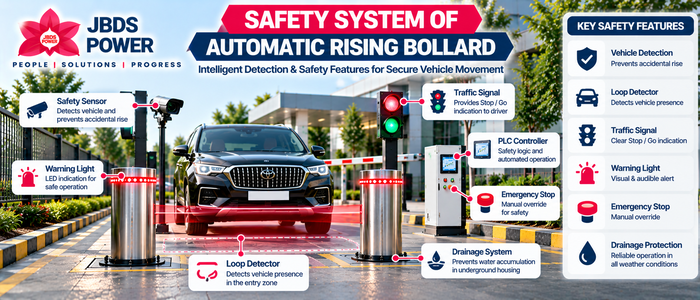
Automatic Rising Bollard Safety System
Safety is an important consideration in any automated road-barrier system.
The system should not rely only on a Raise or Lower command. Vehicle presence and movement around the bollard zone should also be considered.
Depending on the project, the system can incorporate:
• Vehicle Loop Detector
• Safety Sensor
• Traffic Signal
• Warning Light
• Audible Warning
• Emergency Stop
• Manual Override
• Access-Control Interlocks
• PLC Safety Logic
For example, if a vehicle remains positioned above the bollard after authorization, the detection system should prevent an automatic rise command until the controlled area has been cleared.
This is why site-specific engineering is important for an automatic bollard installation.
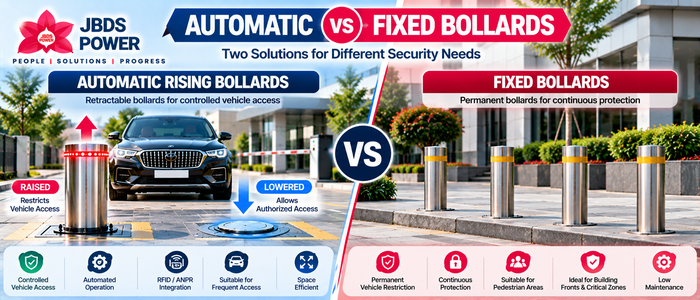
Automatic Rising Bollards vs Fixed Bollards
Automatic and fixed bollards can both help control vehicle movement, but they serve different operational requirements.
Fixed Bollards remain permanently above ground and are suitable where vehicles should not normally pass through a protected area.
Automatic Rising Bollards can retract below road level when authorized vehicle access is required.
The basic difference is:
FIXED BOLLARD → Permanent Vehicle Restriction
AUTOMATIC RISING BOLLARD → Controlled Vehicle Restriction + Authorized Access
Automatic systems are therefore particularly useful where entrances need both security and frequent vehicle movement.
Fixed bollards can remain suitable for building fronts, pedestrian areas, machinery protection and permanent restricted zones.
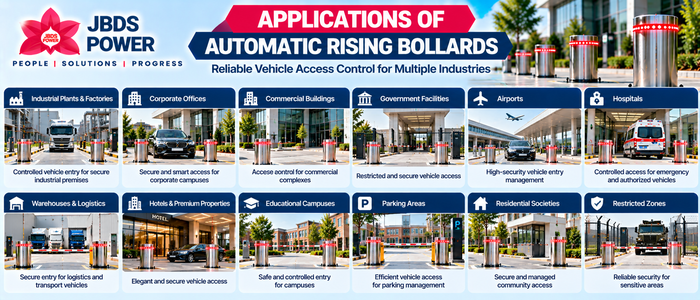
Applications of Automatic Rising Bollards
Automatic rising bollards can be used wherever controlled vehicle access is required.
Typical applications include:
• Industrial Plants & Factories
• Corporate Offices
• Commercial Buildings
• Government Facilities
• Warehouses & Logistics Parks
• Hotels & Premium Properties
• Airports
• Metro & Infrastructure Projects
• Hospitals
• Educational Campuses
• Parking Entrances
• Residential Societies
• Restricted Zones
• Critical Entry Points
• Public Infrastructure
• High-Traffic Controlled Entrances
JBDS Power's current bollard portfolio targets industrial plants, warehouses, commercial properties, airports, government facilities, parking areas and public infrastructure, among other applications. JBDS Power
Benefits of Automatic Rising Bollards
A properly engineered automatic bollard system can provide several advantages for controlled vehicle entrances.
• Controlled Vehicle Access – Authorized vehicles can enter while unauthorized movement remains restricted.
• Automated Operation – Reduces the need to manually remove and reinstall barriers.
• Access-Control Integration – Can work with RFID, access cards, ANPR and other control systems.
• Efficient Traffic Management – Helps organize vehicle entry and exit.
• Space-Efficient Design – The bollard retracts underground instead of requiring gate swing space.
• Pedestrian-Area Protection – Can help separate controlled vehicle paths from pedestrian areas.
• Professional Appearance – Suitable for premium commercial and corporate entrances.
• Customized Operation – Control logic can be developed according to project requirements.
• Integration Capability – Can operate with traffic signals, sensors, barriers and centralized security systems.
• Suitable for Frequent Access – Particularly useful where authorized vehicles regularly enter and exit.
JBDS Power also lists access control, pedestrian safety, building/equipment protection, traffic management and site security among the benefits of its bollard solutions. JBDS Power
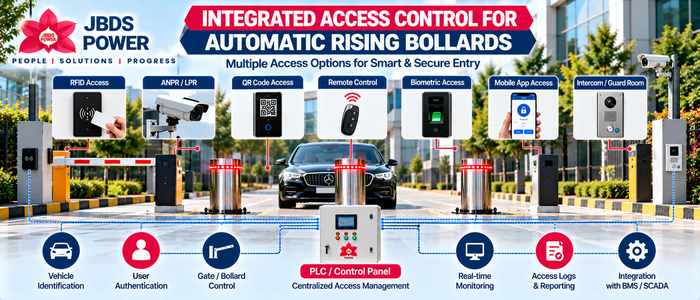
Hydraulic Automatic Rising Bollards
Automatic bollards can use different actuation technologies depending on product design and project requirements.
A hydraulic rising bollard uses a hydraulic mechanism to raise and lower the bollard cylinder.
Hydraulic operation can be suitable for applications requiring regular automated operation, but the appropriate system should be selected according to operating frequency, bollard dimensions, environmental conditions and project requirements.
The engineering should also consider:
• Required Raise / Lower Cycle
• Frequency of Operation
• Vehicle Traffic
• Bollard Dimensions
• Installation Depth
• Power Availability
• Drainage Conditions
• Environmental Exposure
• Control Architecture
• Maintenance Requirements
The operating mechanism should therefore be selected as part of the complete system design rather than on the basis of one feature alone.
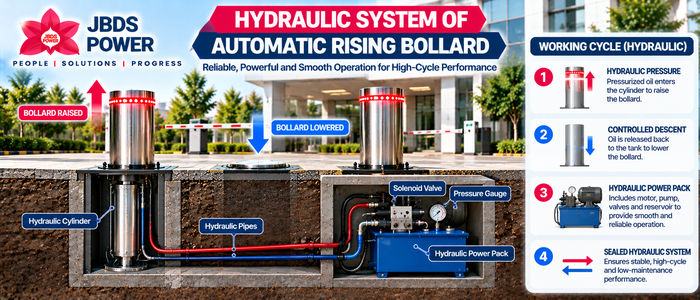
How to Select the Right Automatic Rising Bollard
Automatic bollard selection should not be based only on bollard diameter or appearance.
The complete application should first be evaluated.
Important selection parameters include:
• Application Type
• Vehicle Type
• Daily Traffic Volume
• Frequency of Bollard Operation
• Required Security Level
• Bollard Height & Diameter
• Road Construction
• Available Foundation Depth
• Underground Utilities
• Drainage Conditions
• Access-Control Requirement
• RFID / ANPR Requirement
• Safety Sensor Requirement
• Environmental Conditions
• Electrical Power Availability
• Integration with Existing Security Systems
There is also an important distinction between a general access-control bollard and a certified crash-rated security bollard.
A standard automatic bollard should not automatically be described as crash-rated or anti-ram. Such performance claims should only be made where the particular bollard system has been tested and certified to the applicable standard. This distinction is also made in JBDS Power's current bollard guidance. JBDS Power
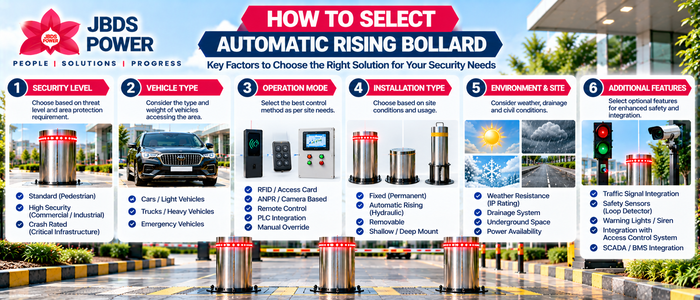
Installation Process of Automatic Rising Bollards
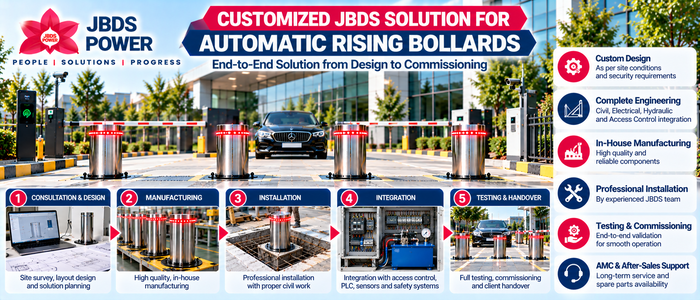
Proper civil, mechanical and electrical installation is essential because a significant part of an automatic bollard system is installed below road level.
A typical project sequence can include:
• Requirement Discussion – Understand traffic flow, access-control requirement and intended application.
• Site Survey – Review road construction, available depth, utilities, drainage and installation area.
• System Selection – Determine bollard type, dimensions, operating method and controls.
• Engineering – Prepare mechanical, civil, electrical and automation requirements.
• Civil Work – Prepare foundation and underground installation area.
• Drainage Preparation – Develop suitable drainage according to site conditions.
• Electrical Cabling – Prepare power, sensor and control cabling.
• Bollard Installation – Install underground housing and bollard equipment.
• Control Integration – Connect controller, sensors, RFID, ANPR or other access systems.
• Testing – Verify Raise / Lower operation, detection and safety logic.
• Commissioning – Validate the complete entrance-management sequence.
JBDS Power's published process similarly covers requirement discussion, site survey, system selection, engineering/manufacturing, civil and electrical preparation, installation, integration/testing, and commissioning/support. JBDS Power
Automatic Bollard Integration with Boom Barrier & Security Systems
For larger facilities, an automatic rising bollard does not have to operate as a standalone security device.
It can form part of a layered entrance-management system.
One possible architecture is:
ANPR / RFID
↓
ACCESS CONTROL
↓
BOOM BARRIER
↓
TRAFFIC SIGNAL
↓
AUTOMATIC BOLLARDS
↓
LOOP DETECTOR / SAFETY SENSOR
↓
SECURITY CONTROL ROOM
The boom barrier can help manage normal vehicle flow while the automatic bollard provides an additional physical access-control layer.
The exact sequence should be engineered around site traffic, authorization procedures and security requirements.
Customized Automatic Rising Bollards by JBDS Power
Every entrance has different road conditions, vehicle flow, security requirements and access-control architecture.
JBDS Power therefore provides customized bollard solutions according to project-specific requirements rather than treating every site as an identical installation.
The project scope can include:
• Requirement Analysis
• Site Survey
• Bollard Selection
• Customized Design & Fabrication
• Mechanical Engineering
• Electrical Engineering
• PLC / Controller Integration
• RFID Integration
• ANPR Integration
• Vehicle Detection
• Traffic Signal Integration
• Civil Installation Coordination
• Installation & Commissioning
• Testing
• Technical Support
JBDS Power's current bollard capabilities include in-house manufacturing, custom design and fabrication, PAN-India supply and installation, engineering support and after-sales assistance. JBDS Power
Why Choose JBDS Power for Automatic Rising Bollards?
Automatic bollards combine mechanical equipment, underground civil work, electrical controls, vehicle detection and access-control automation.
Working with an engineering partner capable of considering the complete system can simplify project integration.
JBDS Power provides customized safety and security bollard solutions backed by engineering and industrial automation capabilities.
Current JBDS Power capabilities include:
• Automatic Rising Bollards
• Fixed & Removable Bollards
• Customized Bollard Manufacturing
• Control Panel Integration
• PLC & Automation Integration
• Access-Control Integration
• Mechanical & Electrical Engineering
• PAN-India Supply & Installation
• Installation & Commissioning
• Technical & After-Sales Support
The objective is to develop a bollard system around the actual vehicle-flow, security and site requirements rather than supplying only an isolated roadside component. JBDS Power
Frequently Asked Questions About Automatic Rising Bollards
What is an Automatic Rising Bollard?
An Automatic Rising Bollard is a retractable road barrier that can rise above ground to restrict vehicles and lower into an underground housing to permit authorized access.
How does an automatic bollard work?
An access-control device or operator sends an authorization command to the controller. After the required safety conditions are satisfied, the bollard lowers. Once the vehicle passes and clearance is confirmed, the bollard rises again.
Can automatic bollards work with RFID?
Yes. An appropriately configured system can be integrated with RFID-based vehicle access control.
Can automatic bollards be integrated with ANPR cameras?
Yes. ANPR can form part of the access-control architecture where vehicle-number-plate authorization is required.
Can automatic bollards work with a boom barrier?
Yes. Automatic bollards and boom barriers can be integrated as different layers of a vehicle entrance-management system.
Are automatic bollards suitable for factories?
Yes. Industrial plants are among the applications identified by JBDS Power for bollard-based vehicle access and safety systems. JBDS Power
Are all automatic bollards crash-rated?
No. Access-control bollards should not automatically be treated as certified crash-rated systems. A crash-rating claim requires the particular product/system to have the appropriate testing and certification. JBDS Power
What details are required for an automatic bollard quotation?
Useful information includes site location, number of bollards, vehicle type, traffic frequency, road/foundation conditions, required bollard dimensions, access-control method and security requirement.
Looking for Automatic Rising Bollards for Your Project?
If your industrial plant, corporate facility, commercial property, parking entrance, warehouse or secured facility requires controlled vehicle access, JBDS Power can evaluate the site and develop a customized Automatic Rising Bollard System.
For faster project evaluation, share:
Site Location + Number of Bollards + Entrance Width + Vehicle Type + Daily Traffic + Access-Control Requirement + RFID/ANPR Requirement + Site Photos / Layout + Required Security Level
JBDS POWER GROUP
Plot No. 302, Sector 7, IMT Manesar, Gurgaon, Haryana – 122052
Phone: +91 7290054361
Email: digital@jbdspower.com
Email: info@jbdspower.com
These contact details match the current JBDS Power website. JBDS Power